Lighting
Lumens vs Watts: How Bright Is a 14W LED Bulb?
Watts tell you how much electrical power a lamp uses. Lumens tell you how much visible light it produces. Modern LED shopping starts with lumens.

Key takeaways
- Watts measure electrical power input; lumens measure visible light output.
- LED lamps can produce the same lumen output using far less power than incandescent lamps.
- Luminous efficacy, expressed in lumens per watt, helps compare how effectively a lamp converts electrical power into visible light.
- Room brightness also depends on beam distribution, fixture shape, wall colours, mounting position and room size — not lumens alone.
Watts are not a measure of brightness
For decades, people learned to associate incandescent wattage with brightness because bulbs of a given technology had fairly predictable efficiency. A 100W incandescent bulb was brighter than a 60W incandescent bulb, so wattage became a convenient shortcut.
LED technology breaks that shortcut. Two LED lamps using the same power can produce different amounts of light. The more useful brightness specification is luminous flux, measured in lumens (lm).
What does 1600 lumens mean?
The U.S. Department of Energy's buyer guidance uses 1600 lumens as the approximate light-output class historically associated with a 100W incandescent lamp, while efficient LED products can reach that output using a small fraction of the electrical power.
That comparison is useful as a mental reference, but it does not mean every 1600-lumen lamp will illuminate a room identically. Optical distribution, diffuser design, fixture geometry and where the lamp is installed all affect perceived brightness.
| Light output | Typical legacy incandescent reference | LED power range in DOE example |
|---|---|---|
| 450 lm | 40W | 4.5–7W |
| 800 lm | 60W | 5.9–10.5W |
| 1100 lm | 75W | 9.5–14W |
| 1600 lm | 100W | 10.5–18W |
Lumens per watt: useful, but not the only quality metric
Luminous efficacy is calculated by dividing light output in lumens by electrical input power in watts. A higher lm/W value means more visible light is produced for each watt consumed under the stated test condition.
Efficiency should not be optimised in isolation. A premium smart lamp also needs acceptable colour quality, driver stability, thermal management, wireless electronics, dimming range and useful lifetime. Those functions consume electrical and thermal budget too.
How this applies to Orbit Standard and Orbit Pro
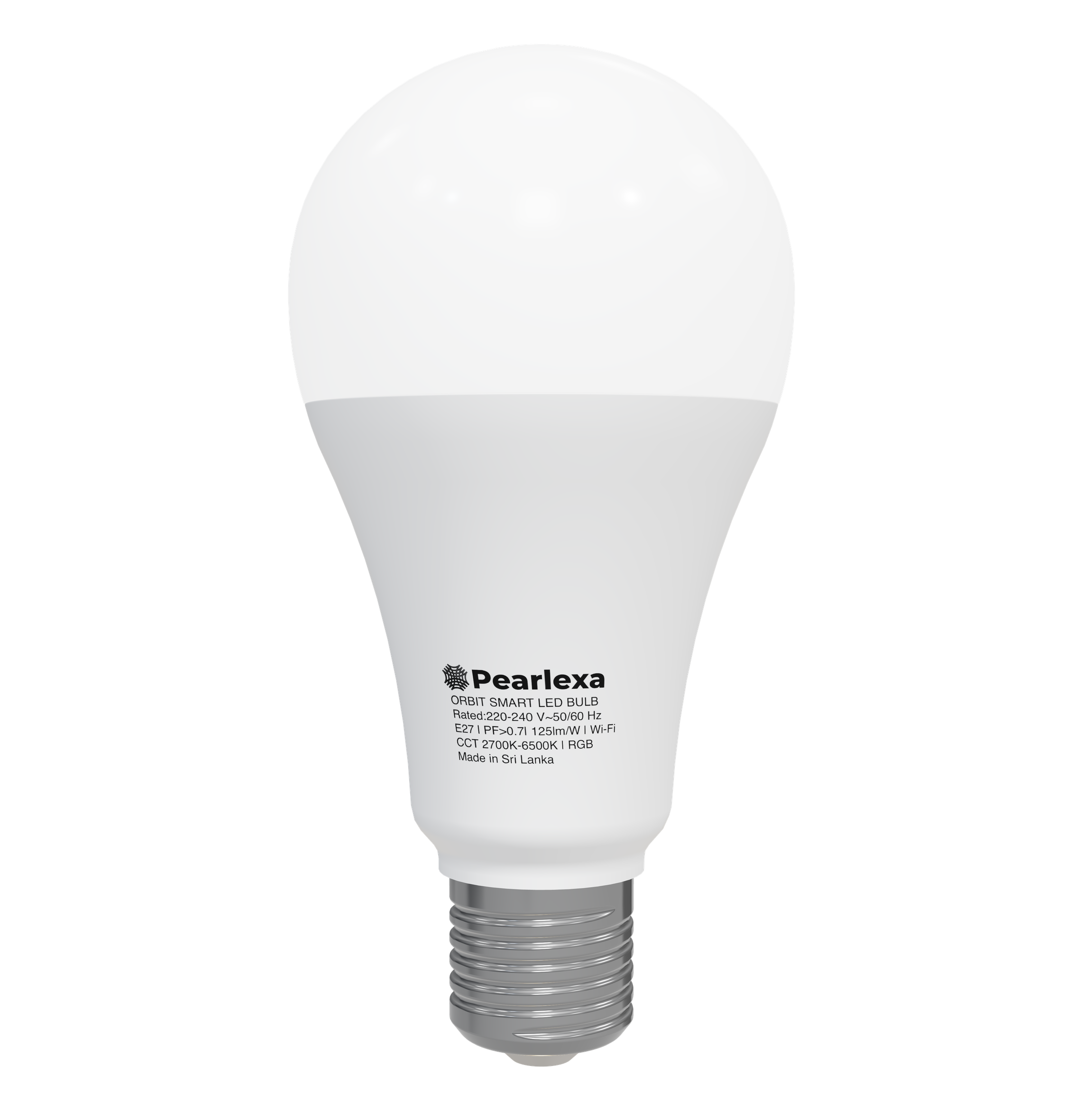
Orbit Standard is specified at approximately 1600 lm at 4500K with a maximum total lamp power of 14W. Orbit Pro targets approximately 1900–2000 lm at 4500K at the same 14W maximum power, reflecting a different LED and driver design target.
These are product-level specifications, not a promise that every room will appear equally bright. The right lamp count and placement depend on the space and the lighting task.
Compare Orbit Standard and Orbit ProSources and further reading
Pearlexa uses primary technical and regulatory sources where practical. External sources remain the property of their respective publishers.
Editorial & intellectual-property note
This article explains public product characteristics and general engineering principles. Pearlexa does not publish confidential schematics, source code, security keys, proprietary protocols, manufacturing tolerances or unpublished design files. Text and original Pearlexa imagery are © Pearlexa Pvt Ltd unless otherwise stated.
Read our editorial policy